Daily Dance Break For Your Health

Turn on "September" by Earth, Wind & Fire right now. I'll wait. Notice something? Your shoulders just moved. Maybe your foot tapped. Something in you responded before your brain even processed what was happening. That's not coincidence — that's biology. And in the world we're living in right now, it might just be one of our most underrated tools for staying whole.
We Are Living in Stressful Times
Let's be honest. The current political climate — regardless of where you stand — has created an undercurrent of anxiety, division, and fatigue that touches virtually everyone. Seniors, who often rely on routine, community, and connection for their wellbeing, are particularly vulnerable to the emotional toll of a polarized, uncertain world. And yet, the answer might not be a new policy or a new medication. It might be a playlist.
"The body remembers what the mind tries to forget. Music unlocks it — and movement sets it free."
What the Research Actually Shows
The science here is not subtle. Movement and music together create a neurological cascade that antidepressants work hard to replicate. Studies have shown that just 10 minutes of rhythmic movement can significantly lower cortisol (our primary stress hormone), boost serotonin and dopamine, and reduce the perception of pain. For seniors specifically, the benefits go even deeper.
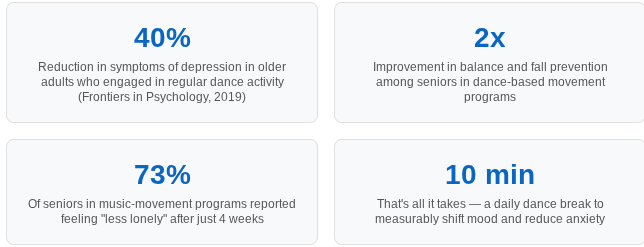
That's all it takes — a daily dance break to measurably shift mood and reduce anxiety
Beyond the physical, there is something profound that happens when an 80-year-old hears "Respect" by Aretha Franklin and starts to move. Memory, identity, joy — they surface. Cognitive engagement increases. Isolation recedes. For a population too often sidelined by our culture, that 10-minute dance break says: you are still here, you still matter, and your body still knows how to feel good.
Why R&B from the '60s Through the '80s Works So Well
This isn't arbitrary nostalgia. For most of today's senior population, these songs were the soundtrack of their 20s, 30s, and 40s — the years of peak emotional memory formation. Research on autobiographical memory confirms that music from these years triggers exceptionally strong emotional recall, even in individuals with dementia or cognitive decline. When a senior hears "Dancing in the Street" or "Superstition," they aren't just hearing a song. They are, for a moment, the person they were when that song meant everything. That reconnection with self is genuinely therapeutic.
💡 Practical Tip
Structure your daily dance break with 1 mid-tempo warm-up song, 2–3 upbeat songs, and 1 slower cool-down. Same time every day builds the habit. Invite staff, family, and caregivers to join in — the shared experience multiplies the benefit for everyone in the room.
This Isn't Just for Seniors
Here's what I want every HR leader, wellness coordinator, teacher, and parent reading this to internalize: the benefits of a daily dance break are not age-limited. In workplaces dealing with burnout and disengagement. In classrooms struggling with focus and anxiety. In families trying to stay connected across generational and political divides. A three-minute dance break together does something that a difficult conversation often cannot — it reminds us that we share a body, a rhythm, a humanity. It is extraordinarily hard to feel contempt for someone you just danced with.
In a time when we are deeply fractured — politically, socially, generationally — shared joy is not a trivial thing. It is, in fact, a radical act of community building. A senior in a care facility dancing to "Brick House" with a 25-year-old staff member isn't just having fun. They are, for that moment, building the only bridge that actually lasts: a human one.
How to Start Today
You don't need a gym, a budget, or a program. You need a speaker, a playlist, and the willingness to move. Whether you're running a senior living community, managing a team, raising kids, or simply trying to take care of yourself — here is your invitation. Pick three songs from each decade of the 1960s, 70s, and 80s. Set a daily alarm. When it goes off, get up and move for 10 minutes. That's it. Watch what happens over 30 days. To the mood. To the energy. To the relationships.
We spend enormous amounts of time and money trying to solve the problems of isolation, mental decline, anxiety, and disconnection. Sometimes the answer has been in our hips all along.


Comments